 Gilles Crofils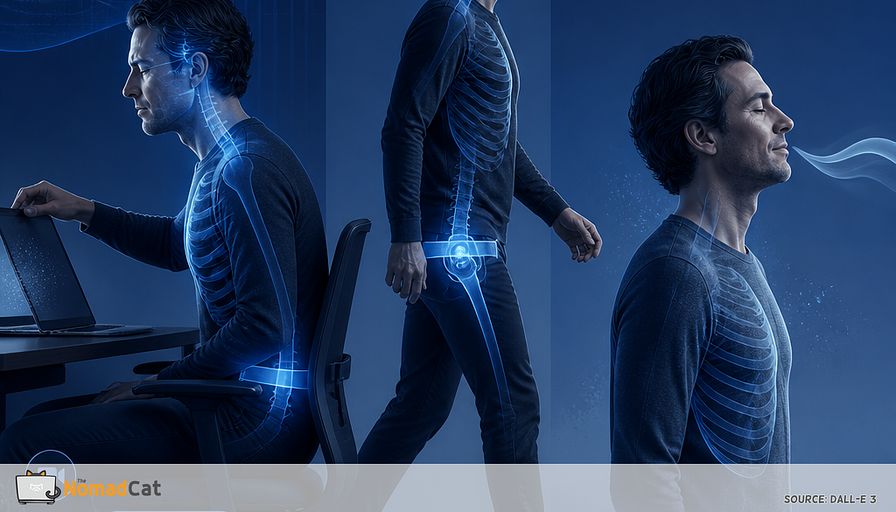
You are fine all day. Then you close the laptop, stand up, and the 1st 10–30 steps feel… off. Low back and hips like a tight belt. Shoulders a bit too high. Breathing stuck in the upper chest. And then, annoyingly, it fades. Nothing “happened,” so what exactly is the problem supposed to be.
I’ve had this across too many desks in too many time zones—Beijing, then Berlin, now Lisbon—often well past midnight. The common pattern is the same: things feel “fine” right up until they don’t.
That delayed timing is the clue. A lot of desk strain does not announce itself during the task. It shows up right after, when the demand drops and the system finally stops ignoring signals.
This is for people who do not want posture religion, an ergonomics shopping spree, or a new 45-minute plan wedged between meetings and dinner. The goal is smaller. Treat your body like a system with logs, feedback loops, and a few high-leverage inputs you can tweak without making it a whole lifestyle.
Here is the weird part that makes it practical. The upstream lever is often not your low back. It is your face.
You will see how “precision mode” can quietly freeze the eyes, jaw, and neck during focused screen work, why camera-on professionalism can turn into an all-day isometric hold, and how screen stuff like reduced blinking and dry eye can keep the squint-and-brace loop running. From there, it links down to ribs and breathing, then to hips going a bit offline, and finally to that shutdown stiffness in the first steps.
Then it gets simple on purpose.
- What to notice without turning it into a hobby
- 1 boring outcome metric that beats dashboards
- A 10-second “face unfreeze” patch triggered by event cues like Send or leaving a call
- Guardrails for when not to troubleshoot and just get checked
No heroics. Just a small debug idea you can test in real life, where the calendar is already full and the laptop will still close at the end of the day.
When the laptop closes
Fine all day then the 1st steps feel weird
The delayed timing is the clue. Strain often shows up right when demand stops—because your brain stops suppressing signals once the task ends (Meijman & Mulder, 1998). During the workday, attention can turn down body messages for a while. A bit like logs that only appear once the process ends (Eccleston & Crombez, 1999). Nothing “broke” at 18:05. You just stopped masking it.
There is a good upstream clue, and it’s not the low back at first. At shutdown, many people notice the face.
Brows locked. Small squint. Lips compressed. Teeth almost touching. Tongue pushing. Jaw “on.” It feels unrelated, which is exactly why it matters.
This is not posture religion. It is not an ergonomics shopping list. And it’s not a new 45-minute routine you will magically fit between 3 meetings and dinner. Think of it as a tiny debug idea that uses event cues so it actually happens in real life (McDaniel & Einstein, 2000; 2005), with an if-then patch mindset (Gollwitzer & Sheeran, 2006).
Why the face gives you away
Precision mode recruits a quiet freeze
Precision tasks flip a specific mode.
Editing a contract. Debugging. Careful writing. Pixel nudging.
The eyes narrow, the face stabilizes, and breathing timing shifts a bit under mental load (Wientjes, 1992; Boiten et al., 1994). It is not dramatic clenching. It is more like a continuous micro-freeze: useful for accuracy, expensive when it runs all day.
Camera on turns professionalism into an isometric hold
Add the social layer. Camera on, approvals, someone important watching.
A common version: the quarterly review on Zoom where you’re “listening,” but you’re also holding a polite half-smile, brows slightly raised, teeth almost touching so you don’t interrupt. It looks like being professional. It is also a long isometric hold.
This stacks with a workday chopped by interruptions (Mark et al., 2008) and the resumption cost of keeping a task in working memory (Altmann & Trafton, 2002).
Screen physiology adds its own loop
Even on low-stress days, screens add another feedback loop.
Blink rate tends to drop during VDU work (Patel et al., 1991). Incomplete blinks are more common, which can contribute to dry eye symptoms (TFOS DEWS II, 2017). Mild blur and dryness can trigger squinting, which recruits forehead and around-the-eye effort, which makes the precision face stickier—a small input running for hours.
The face is high leverage
Pragmatically, the face is fast to change, socially invisible, and always available. Small adjustments can compound because context cues run habits on autopilot (Wood & Neal, 2007), and repetition builds automaticity over time (Lally et al., 2010).
Even if meetings stay awful, the face is still an upstream lever.
From eyebrows to low back without drama
The face and neck behave like a paired system
If the precision face idea is real, it should not stay in the face.
Eye effort and brow tension often come with a small neck hold to steady the head for near vision. Efficient for accuracy. Expensive when it never turns off. Research on sustained screen work supports the idea that static holding drives a lot of neck/shoulder load (Wahlström, 2005).
A boring check near end of day can catch it.
- If the face is tight, the head often stops re-centering over the spine
- Shoulders creep up a few millimeters
- The base of the neck feels “compressed”
Not a diagnosis. Just a pattern.
Jaw posture is one of the easiest dials in this chain. Tooth contact increases jaw-elevator activity, while rest posture reduces it (Gauer & Semidey, 2015; Lobbezoo et al., 2018; 2020). You can change that without rearranging your whole workstation.
Once the neck stays “on,” breathing often shifts upward without anyone choosing it. Under mental load, respiratory timing changes are a known effect (Wientjes, 1992; Boiten et al., 1994). That rib and breathing bottleneck is where the low-back invoice gets set up.
Ribs and breathing become the bottleneck
Desk breathing under cognitive load is often faster and smaller. Sometimes the exhale does not fully finish. Not because someone is “bad at breathing,” but because attention biases timing and rhythm (Wientjes, 1992).
There is also a simple CO₂ note: if you breathe more than you need, you can blow off too much CO₂ and feel odd (Meuret et al., 2005). This is not a reason to panic. It is just why dramatic inhale loops can backfire. Small is usually better.
Mechanically, when the ribcage contributes less to expansion and rotation, the trunk behaves more like a rigid cylinder. Great for precision. Annoying when you stand up and suddenly need extension and rotation for normal walking (Crosbie et al., 2003).
When the ribs do less, something else has to do more. The low back is an eager intern.
This also helps explain why the invoice arrives at shutdown. Attention can suppress pain signals during the task (Bantick et al., 2002). You close the laptop, the demand drops, and the buffering stops—often marked by the first real sigh (Li et al., 2016).
How hips go offline and the low back fills the gap
Standing and walking need hip extension and pelvis-thorax rotation. If hip extension and trunk rotation are temporarily offline, the low back often takes extra motion and load, consistent with hip-spine shared load ideas (Offierski & MacNab, 1983; Reiman et al., 2009).
Sit-to-stand is basically a coordination stress test (Schenkman et al., 1990; Pai & Rogers, 1991). If the trunk is still braced, you stand as 1 piece. The first steps feel short and stiff, like the hips did not receive the memo.
And yes, boring but correct. This is association, not a single-cause claim. Low back pain has many inputs. Nobody needs a theory that blames their spine on their eyebrows. Red flags deserve proper evaluation, not posture detective work (Chou et al., 2007; NICE NG59).
Log files that point upward
What to notice without turning it into a hobby
If the eyes are the top of the chain, the mouth is often the middle.
Eye and face logs during precision work
- rereading the same line while squinting in good light
- forehead “stuck”
- eyes dry or gritty
- blink rate quietly dropping (Patel et al., 1991)
Mouth and jaw logs
- teeth almost touching
- lips pressed
- tongue pushing up or back
- jaw hovering like it is “ready”
This is rarely dramatic clenching. Awake bruxism discussions are often about subtle daytime tooth contact, and changing that contact is one of the few invisible dials you can touch (Lobbezoo et al., 2018; 2020).
A transition-only clue
If the 1st real exhale is a big sigh right after closing the laptop, that is a decent log entry that breathing was constrained while you were focused.
Once you have 3 or 4 logs, you can test correlation instead of debating theory. If face logs spike on edit days, approval days, or camera days, and the low-back invoice spikes after, then you have a lever.
1 boring metric that beats a dashboard
Use “steps until normal” as the outcome.
Count the steps after standing up until gait feels like your baseline again. Not pain score theater. Just function.
Unlike HRV, or whatever your Polar H10 or Decathlon sport watch is saying that week, this is the simplest sensor you already have.
Meaningful change is usually about what you notice in daily output, not perfect graphs (Ostelo et al., 2008; Farrar et al., 2001).
Interpret the trend, not Tuesday. Give it 7 days and look for direction.
If symptoms worsen, spread, or you get red-flag signs like progressive weakness, numbness, or bowel or bladder changes, stop and get checked (NICE NG59).
The 10-second face unfreeze patch
Trigger it from seams not memory
A timer asks you to keep monitoring the clock, which is already scarce in knowledge work. A seam like hitting Send is event-based, so the cue is free and more reliable (McDaniel & Einstein, 2000; 2005).
Good seams have a clean end state and a small pause built in.
- Send message or email
- Leave call
- Export build render finishes
- Close a doc
Too many triggers adds noise and makes resumption harder (Altmann & Trafton, 2002). 2–3 is enough.
Tab switching is a trap. It happens 400 times, means nothing, and your brain will stop seeing it.
A patch recipe that stays small
- Soften the eyes for 2 seconds. Slightly widen focus, like going from laser pointer to headlights
- Do 2 slow complete blinks without squeezing (TFOS DEWS II, 2017)
- Teeth apart. Tongue wide and soft. Lips can stay closed
- Make 1 quiet exhale longer than usual, and do no big inhale after
The goal is to finish an exhale and reduce trunk bracing, not to turn this into breathwork or to get lightheaded. Big inhale loops can drift into overbreathing and feel weird for some people (Meuret et al., 2005).
Optional add-on before standing, under the desk and almost invisible.
- press heels lightly for 1 second
- or slide 1 foot half a shoe length forward
This helps avoid standing up as 1 piece (Schenkman et al., 1990; Pai & Rogers, 1991).
Proof without making it a project
A 7-day A B check with 1 metric
For 7 days, run the 10-second patch only at 3 reliable seams per day.
Track 1 outcome metric.
- steps until normal
- or first-stand complaint yes/no
If nothing changes, that result is still useful. It probably means the lever is elsewhere. Keep the response proportional. Do not add 5 new knobs “to be sure.” Effort debt likes to show up later (Meijman & Mulder, 1998).
Failure modes that kill the patch
- Turning it into deep breathing. Do not do big inhale loops
- The “try harder” trap. Forcing relax your face adds effort. Treat it like clearing a stuck keyboard key
- Relying on when i remember. Under load, you will not. Event cues are part of the intervention (McDaniel & Einstein, 2000; 2005)
- Doing it all day. Too many reps becomes noise. 3 seams is how it stays doable and becomes automatic over time (Lally et al., 2010)
Guardrails that beat desk experiments
Back and nerve signs that override everything
Stop and get medical evaluation if there is progressive weakness, persistent numbness or tingling, bowel or bladder changes, saddle anesthesia, major trauma, fever, unexplained weight loss, or severe night pain that is worsening (NICE NG59; Chou et al., 2007).
If symptoms escalate, spread, or stop behaving like a short-lived shutdown effect, do not keep tweaking micro patches and chair angles. Get assessed.
Jaw and vision signs that are not just work face
Jaw symptoms that deserve proper evaluation include sharp or electric shock-like pain, jaw locking, progressively reduced opening, new bite changes, swelling, fever, or suspected tooth problems (Schiffman et al., 2014; de Leeuw & Klasser, 2018; ICOP, 2020).
Vision overrides include sudden vision loss, flashes or floaters with a curtain or shadow effect, new binocular double vision especially with headache, or severe headache with new visual change. These are urgent, not screen-settings problems (AAO Preferred Practice Pattern; NICE NG127).
Most desk discomfort is not dangerous. Still, strict stop rules beat endless tweaking.
Track 1 boring metric like steps until normal, and keep the patch small and rare. 3 seams per day is enough.
If the 1st 10–30 steps after laptop-close feel weird, it is not your imagination, and it is not proof that your back is “bad.” Often it is delayed signal, showing up when the system stops buffering. The useful twist is upstream. Precision work can freeze eyes, jaw, and neck, especially on camera, and that quiet brace can push breathing upward, stiffen the ribs, and leave the hips a bit offline when you finally stand.
So keep it boring. Notice a few logs. Track 1 metric like steps until normal. Run the 10-second face unfreeze only at 2–3 real seams like Send or leaving a call. The best seam is the one that already has a built-in pause—because it will still be there on the days you’re too busy to remember anything else.


